Outpatient rehabilitation in Muttenz
Back to everyday life after an injury
Outpatient rehabilitation in Muttenz
Back to everyday life after an injury
Outpatient rehabilitation
Train intensively – and live at home
After surgery or an injury, you do not always need a stay in a clinic. In outpatient rehabilitation you train intensively, at short intervals and, if needed, several times a week – and still sleep in your own bed.
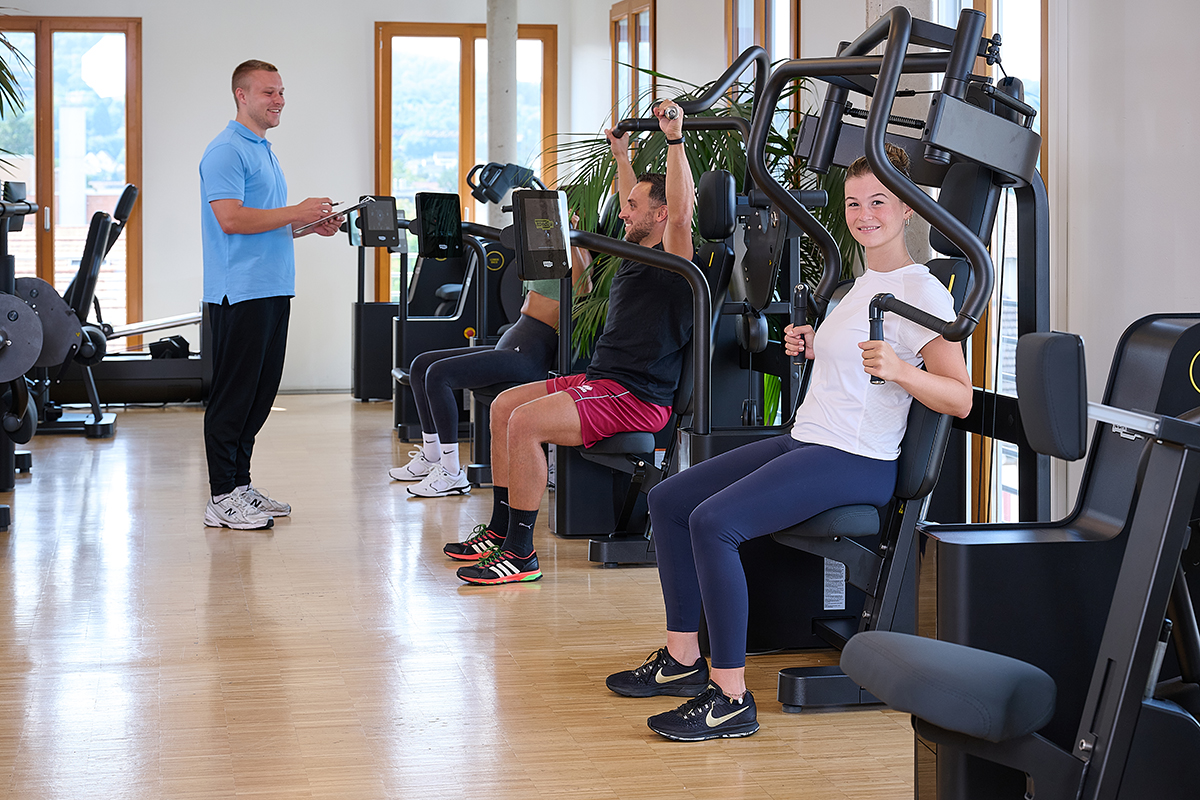
Physiotherapy and medical training take place under one roof with us. This saves journeys and makes the transition back to everyday life, work and sport seamless.
How it works
How outpatient rehab works
Scientific evidence
Why active rehabilitation works
Our approach: As much support as necessary, as much independence as possible – with measurable goals and regular tests.
Indications
Who is outpatient rehab suitable for?
- After hip, knee or shoulder replacement
- After cruciate ligament, meniscus, tendon and shoulder surgery
- After spinal surgery, e.g. for disc herniation or spinal stenosis
- After fractures and accidents
- With osteoarthritis and inflammatory rheumatic conditions
- With persistent pain, e.g. back pain
- With osteoporosis
FAQ
Frequently asked questions about outpatient rehab
How often are the sessions?
Depending on the phase and goal, at short intervals, several times a week if needed. As you become more independent, the intervals get longer.
Who pays for outpatient rehabilitation?
With a doctor’s prescription, physiotherapy and medical training therapy are covered by basic health insurance. We are happy to advise you on planning.
What is the advantage over inpatient rehab?
You stay in your familiar surroundings and practise exactly where you need the movements – in your own everyday life. Inpatient rehab makes sense if you cannot yet manage independently at home.
Can I start before surgery?
Yes – targeted training before surgery (prehabilitation) can make it easier to start rehab. Just ask us.
Sources: Hayden JA et al., Cochrane Review 2021 · Fransen M et al., Cochrane Review 2015 · Fairhall NJ et al., Cochrane Review 2022 (mobility after hip fracture) · Oosterhuis T et al., Cochrane Review 2014 (rehabilitation after disc surgery) · Grindem H et al., Br J Sports Med 2016 (return to sport after ACL reconstruction) · Systematic review of supervised vs. home therapy after knee replacement, Cureus 2023 · Overview on adherence in physiotherapy, Syst Rev 2024
Surgery planned or behind you?
We support you intensively on your way back to everyday life, work and sport.